
GwL address to the 3rd IFGC-WHO Meeting on Addictive Behaviours
GwL Co-Founder and Chair, Charles Ritchie, gave an opening address at the 3rd conference for the World Health Organisation (WHO) Collaborative Project on the Development of International Screening and Diagnostic Instruments for Gaming Disorder and Gambling Disorder (DISDAB), held on 11-12 December 2025 in Istanbul, Turkey.
The project began in 2017 and involves dozens of countries across the world. The conference was jointly hosted by WHO and the International Federation of Green Crescent (IFGC) and brought together over 70 clinicians and researchers from different countries.
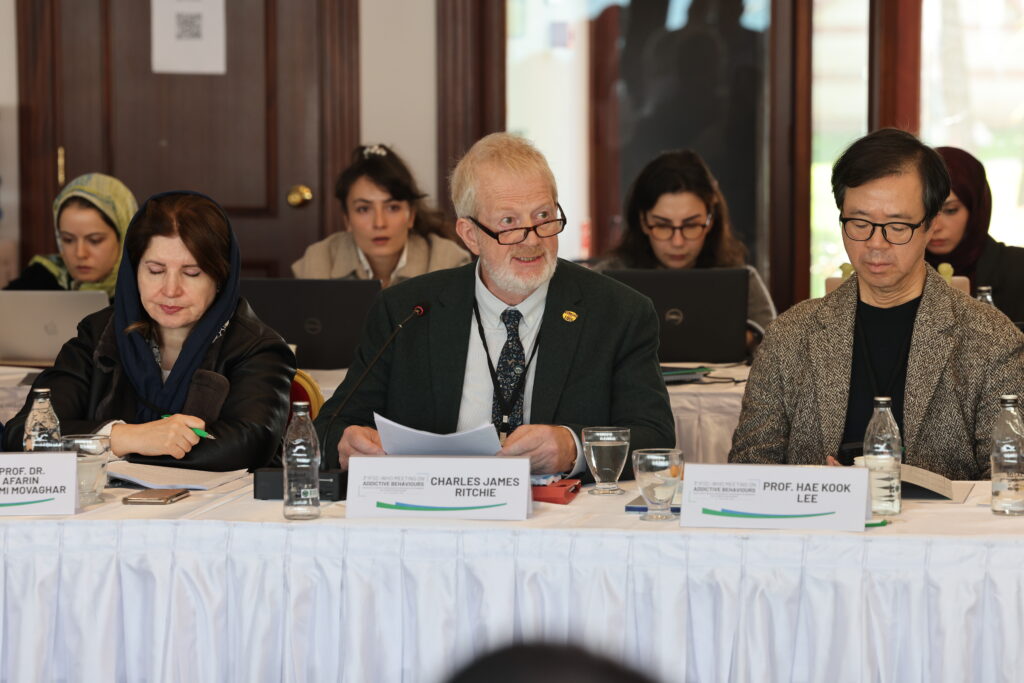
A draft DISDAB has been developed, and the conference was focused on the further development and testing of the new tool in many member countries. But the conference was also committed to determining the role of early identification and diagnostic procedures within the spectrum of public health actions. WHO and member countries have been keen to ensure that the voices of lived experience feature centrally in the debate and in taking forward actions. So GwL had been invited to place this work within the wider context of activities around gambling addiction.
The speech, which was preceded by a showing of the first GwL family film, available to view below, was warmly welcomed and generated a good deal of discussion throughout the conference. We will be working with WHO and IFGC to expand and establish the role of wider lived experience voices in this project and the wider work of both organisations. A copy of the speech is beneath the film.
I’m Charles Ritchie, chair of the UK charity Gambling with Lives and my wife Liz is online. It should have been Liz giving this speech but I’m afraid that she is unwell and back home in the UK. Also online is Chloe Long – from one of the Gambling with Lives families and also a Trustee of the charity.
(Liz on line says the following: I’m sorry that I can’t be with you all but we very much welcome the work that has led to the development of DISDAB and the scale of research that has resulted in the documents we all received last week – people truly working to prioritise the health of the world.)
My son Jack took his life in 2017 and shortly after we founded the charity Gambling with Lives together with a small group of families. Chloe’s brother Ollie took his life in 2024.
The film you’ve just seen was made in 2018, just before our first annual event in the UK Parliament. And it does capture something of the grief and the need for action to prevent further deaths. But the film also shows the beginnings of the reflection and learning that bereaved families have undertaken together to understand what happened to the people we love, to advocate publicly for justice for people killed by gambling, and to stop others dying.
Both Jack and Ollie were bright clever young me from loving happy families and were deliberately addicted to widely advertised health harming gambling products in order to take money from them. Their suicide notes told us that they both felt that their agency had been completely removed and that they would never be free from addictive forms of gambling. And they had also internalised the stigmatising blaming “responsible gambling” narrative: they felt that they were uniquely flawed and individually to blame for their addiction.
In 2022 the inquest into Jack’s death was held under Article 2 of the European Convention for Human Rights – meaning the UK state did not protect his right to life – a UK first for a gambling death. Essentially it found that the information about the risks and dangers of gambling was ‘woeful’ and the availability of effective treatment was totally inadequate.
Subsequent inquests into the death of Luke Ashton in 2023 and Lee Adams this year both found gambling disorder legally to be the medical cause of death and found glaring failures by operators to intervene. These inquests led to Prevention of Future Deaths reports to government – covering and seeking action on these issues. Chloe’s brother Ollie’s inquest will take place next year and that will include a focus on the illegal or ‘black’ market.
These inquests have contributed to major changes in the UK. We’ve now got 15 specialist gambling clinics in England – compared to just one when Jack died. We have a national evidence-based gambling treatment guideline and the UK National Suicide Prevention Strategy now lists gambling as a “dominant factor without the suicide might not have happened”.
Of course, it’s the politicians who really make change happen … and we have already heard today from Beccy Cooper MP, who is the MP for one of the families and an important and effective campaigner for gambling reform – and they were pretty much the only people who really listened when we first started. Action may not happen quickly, but over time the UK gambling landscape is changing.
And bereaved families are powerful advocates – we have given evidence many times to Parliament and this coming year Gambling with Lives will hold our eighth political event in the UK House of Commons – which have heard speeches from Secretaries of State, Ministers and senior clinicians.
Families also speak individually to their MPs who now form a considerable army of supportive politicians. Last week the Prime Minister (under questioning from an MP) assured the House that the government would look at the link between gambling and suicide.
And next year we will be reporting results of a genuinely collaborative research project between lived experience participants and several UK universities looking at gambling and suicide. We are confident that will lead to change.
All of this demonstrates that lived experience offers such much more than stories of harm: it offers insight into the problems and real solutions … and importantly the impetus to force change.
To conclude on DISDAB:
Engaging with forms of gambling that are normalised and advertised as a safe exciting behaviour that promotes friendship and social wellbeing is NOT pathological. It is the entirely predictable result of a collective framing that does not include the commercially driven design of addictive forms of gambling which hijacks the brain. And which does not recognise the predatory marketing that incentivises and exacerbates the behaviour.
Compulsive engagement is what we are all, as a society, inviting people – particularly young people – to do. So we need to be careful that we do not create a narrative that that pathologizes or blames the behaviour of people who have behaved entirely predictably.
So, my technical question to you on DISDAB is where should we be picking up information on an individual’s use of different gambling products … and not as just contextual information? We all recognise that spending 2 hours playing high speed slots is very different to spending 2 hours betting at the races. And it shows in the harm rates … with online slots having ‘problem gambling’ rates 6 times higher than other products.
Of course, it is right to create a clinical tool that measures and categorises the harm that addiction causes … and the sooner that the harm can be recognised for an individual, the better. But it’s also right to recognise that this alone won’t help us get the politicians to act and clean up this mess.
Abusers the world over blame the abused. So, on behalf of the many many people who have died, the challenge that all the work on DISDAB has set us is that we should remain rigorously alert to maintaining a true 2025 public health perspective that includes understanding of the commercial determinants while working on a medical diagnostic model.
We thank you for all your work and look forward to working with you in the future.